
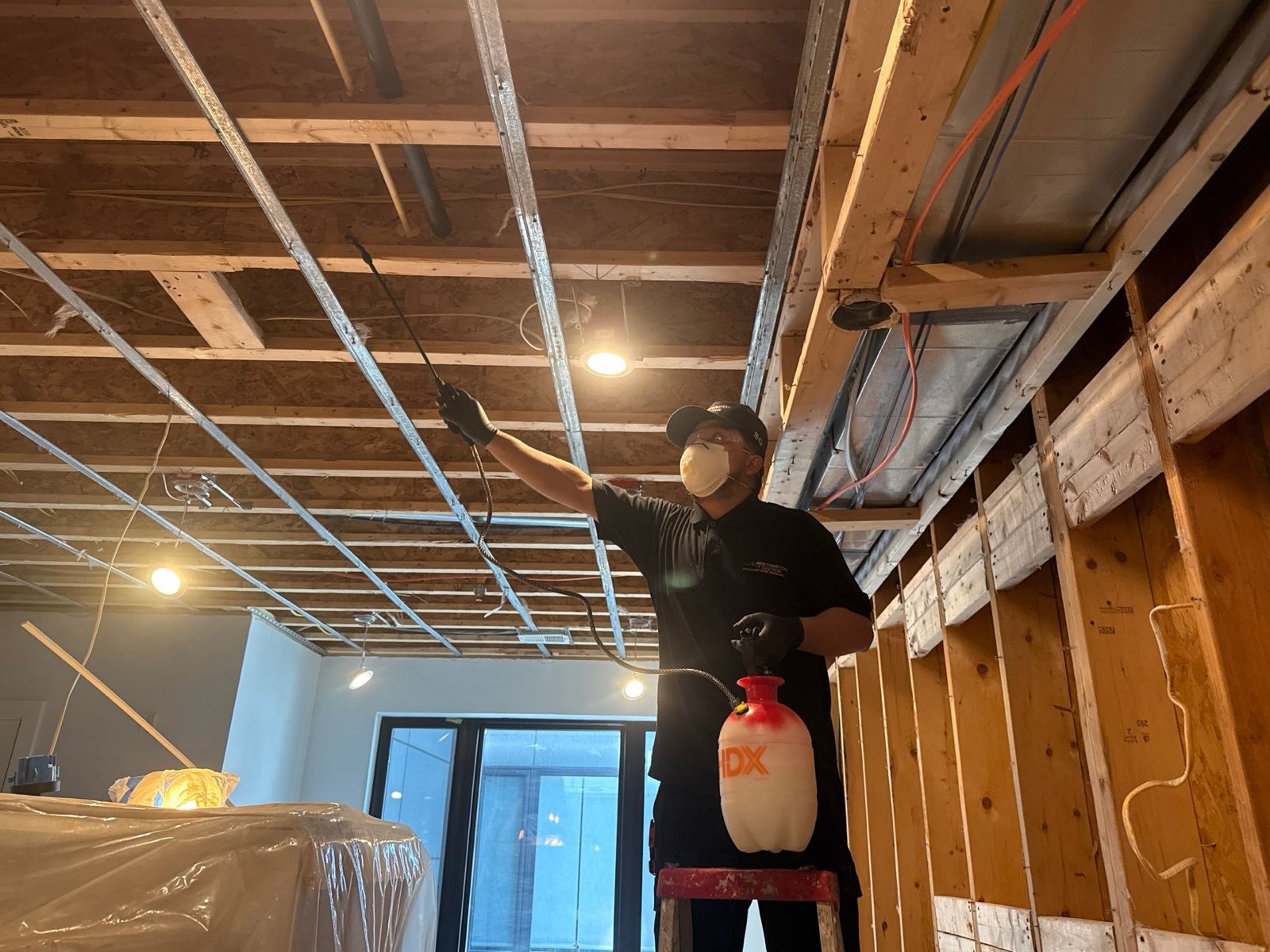
Water Damage Restoration in DUMBO
DUMBO's buildings were built to hold machinery and freight, not modern plumbing stacks — and when water gets loose in a converted warehouse, it behaves unlike anywhere else in the city. Restoration Doctor of NYC provides water damage restoration in DUMBO with methods built for exactly this stock: heavy timber and reinforced concrete structures, exposed brick, open ceilings, and a waterfront location that puts lower levels squarely in the flood conversation.
Between the Manhattan and Brooklyn Bridges, nearly every residential building is a conversion — a former factory or warehouse turned condominium, with the massive columns, plank floors, and arched windows that make the neighborhood what it is. Those same features change how water travels and how drying must be verified. A sprinkler discharge or a failed supply line on an upper floor can run along beam lines and surface two bays away, and timber that reads dry at the surface can stay wet at the core for weeks.
We respond around the clock, coordinate with DUMBO's condo boards and property managers on certificates of insurance and elevator access, and document every loss to IICRC S500 standards. For an active emergency, call (646) 789-6264.
The buildings of DUMBO — and how they fail
DUMBO's signature stock is the converted industrial loft: late-19th and early-20th century warehouses and factory buildings — many originally built for manufacturing concerns along Washington, Water, and Front Streets — rebuilt over the last few decades into loft condominiums. Structures are heavy timber post-and-beam or early reinforced concrete, with brick perimeter walls, high ceilings, and oversized windows. Interiors mix original fabric with modern kitchens, baths, and mechanical systems threaded through a structure that was never designed for them.
That retrofit is where water risk concentrates. Plumbing risers run through chases cut into old structure; washing machines and dishwashers sit over plank subfloors with generous gaps; sprinkler systems protect open-plan units where a single head discharge can reach an entire floor plate. When water escapes, the open ceilings and continuous beam lines that make lofts beautiful also give it long, unpredictable travel paths.
At the edges of the neighborhood, newer construction fills in — modern condo towers near the bridge approaches and along the waterfront, plus a handful of rowhouses toward Vinegar Hill. The new towers behave like any contemporary stacked building: fast pressurized-water losses running down unit stacks. And everything near the East River shares one more exposure: DUMBO's low-lying waterfront blocks sit in mapped flood zones, so cellars, ground-floor retail, and building mechanical rooms carry real coastal storm risk.
How water losses unfold in DUMBO
Drying Heavy Timber and Exposed Brick
Heavy timber is the defining drying challenge in DUMBO. Old-growth beams and plank subfloors absorb water slowly and release it even more slowly. A moisture meter held to the surface a day after a loss can show acceptable numbers while the core of a twelve-by-twelve beam remains saturated. We meter at depth with penetrating probes, log readings over successive days, and keep drying equipment running until the wood itself — not just the air around it — reaches a dry standard.
Exposed brick behaves similarly: it wicks water along mortar joints and holds it in the masonry mass. Efflorescence blooming weeks after a loss is the telltale of a wall that was declared dry too early. Where brick has taken significant water, we establish drying with dehumidification and airflow and verify with follow-up readings rather than a one-time check.
The reward for doing this right is that almost all of DUMBO's original fabric is salvageable. Timber, brick, and concrete rarely need replacement after a water loss — what needs attention is honest, patient drying and removal of the modern porous materials around them that cannot be saved.
Open Ceilings, Sprinklers, and Loft Losses
Open-plan lofts with exposed structure give escaped water room to run. A failed supply line or a sprinkler discharge on an upper floor travels along beams and through plank gaps, and the drip that appears in the unit below is often bays away from the source. Our mapping starts at the source and follows the structure — metering along beam lines in both directions — rather than assuming the wet spot marks the extent.
Sprinkler discharges deserve specific mention because loft buildings carry them through open living space. Sprinkler water arrives fast and in volume, and while the system water itself starts relatively clean, it picks up decades of dust and residue from old structure on the way down. We extract, clean, and dry accordingly.
Many DUMBO units double as studios, galleries, or offices with valuable contents. We stage containment to protect equipment, artwork, and inventory, document contents damage separately from structure, and coordinate specialty conservators when owners engage them — the choice of any specialist is always the owner's.
Waterfront Flood Exposure and Lower Levels
DUMBO's blocks slope down to the East River, and its lowest streets flooded significantly during Hurricane Sandy. Cellars, ground-floor commercial spaces, lobbies, and building mechanical rooms in the flood zone face coastal surge and heavy-rain inundation that upper-floor units never see. Flood water is Category 3 by definition — grossly contaminated — and mitigation means containment, removal of unsalvageable porous materials, thorough cleaning, and antimicrobial treatment per IICRC S500.
For buildings, the highest-stakes flood damage is often mechanical: elevator pits, electrical rooms, boilers, and pumps at the lowest level. We coordinate with building management and their service vendors to document and dry these spaces quickly, because a building without elevators or heat is an emergency of its own.
Costs in DUMBO span a wide range — a contained single-unit loss may run in the low thousands, while a multi-bay timber drying project or a flooded lower level can reach well into five figures. We scope from measurements, not assumptions, and walk owners and managers through the numbers before proceeding.
DUMBO neighborhoods we serve
Real communities — and the water losses we most often see in each.
The postcard blocks — large warehouse conversions where open ceilings and timber structure let water travel far from its source.
Dense loft condo stock between the bridges, with ground-floor retail whose ceilings sit directly under residential plumbing.
Lowest-lying blocks adjacent to Brooklyn Bridge Park with mapped flood-zone exposure for cellars and mechanicals.
Adjacent pocket of Federal-era rowhouses and small walk-ups — a completely different drying problem than the lofts, with plaster and old frame construction.
Newer high-rise condos and conversions near the York Street F station where stacked risers create classic multi-unit losses.
Riverfront conversions and newer towers where wind-driven rain and facade exposure add envelope leak paths to plumbing risk.
Full restoration services in DUMBO
One operation covers every category — from emergency mitigation to full reconstruction.
Water Damage Restoration
Restoration Doctor of NYC provides emergency water extraction, moisture mapping, and structural drying for apartments, co-ops, condos, brownstones, and commercial spaces throughout the five boroughs, working within building rules, insurance documentation requirements, and the realities of vertical living.
Sewage Cleanup
Restoration Doctor of NYC performs emergency sewage extraction, contaminated-material removal, cleaning, and disinfection for sewer backups and drain failures in brownstone cellars, apartment buildings, and commercial spaces throughout New York City.
Mold Remediation
Restoration Doctor of NYC provides containment-based mold remediation for apartments, brownstones, and commercial spaces across the five boroughs, performed in a manner consistent with the IICRC S520 standard and with awareness of New York State and City mold regulations.
Fire Damage Restoration
Restoration Doctor of NYC handles the full arc of fire recovery in New York City properties — emergency board-up and securing, smoke and soot cleaning, odor treatment, water mitigation from firefighting, and structural rebuild — with the building coordination that multi-unit fires demand.
Contents Restoration
Restoration Doctor of NYC provides full contents services for New York City losses: detailed photo inventory, professional pack-out through the realities of NYC building access, specialized cleaning and deodorization, climate-controlled storage outside Manhattan, and coordinated return after rebuild.
Reconstruction
Restoration Doctor of NYC rebuilds water-, fire-, and mold-damaged spaces across the five boroughs, managing the approvals, access logistics, and trade coordination that New York buildings require, and restoring everything from patched drywall to full gut renovations of loss-affected units.
Verify us before you call
Our customer feedback lives on the network's verified reviews hub and on our New York City Google Business Profile — source-linked aggregates, never numbers typed onto a marketing page. Check both, then call.
Frequently asked
Active water, mold, fire, or sewage event?
Connect directly with the Restoration Doctor team for your region. Crews are on standby 24/7 with documented response protocols.
Financing available through Stripe, subject to lender approval.