
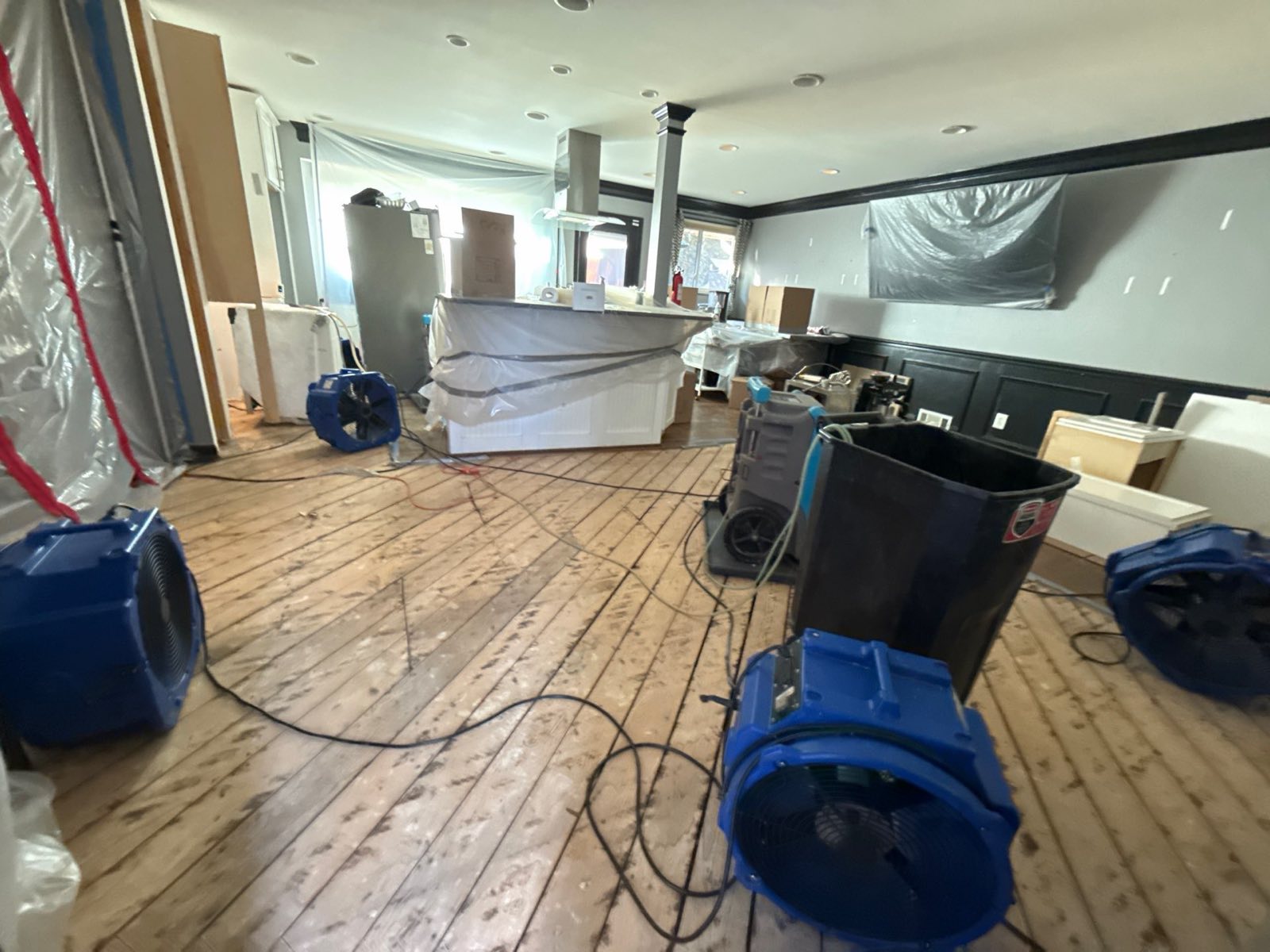
Water Damage Restoration in Astoria, Queens
Astoria's brick rows and pre-war walk-ups have carried generations of families, and their plumbing has carried nearly a century of service. Restoration Doctor of NYC provides water damage restoration in Astoria built for this stock: galvanized branch lines that finally let go inside shared walls, steam risers that fail on the season's first cold night, roof leaks over top-floor apartments, and the basement apartments and cellars that take on water every time a serious storm overwhelms the sewers.
This is a neighborhood of six-family walk-ups, attached two- and three-family homes, and small landlord-owned buildings where the owner often lives upstairs and the super is a phone call, not a management office. We work at that scale — direct, fast, and clear about what the meters actually show — while also handling the larger co-op buildings and newer mid-rises that have filled in along 31st Street, Ditmars, and the waterfront.
Every Astoria loss gets the same discipline: IICRC S500 drying standards, moisture readings documented from arrival to completion, and honest scoping so owners and their insurers see exactly what was wet, what was dried, and what had to be removed. For emergencies, call (646) 789-6264 any hour.
The buildings of Astoria — and how they fail
The backbone of Astoria housing is the pre-war walk-up: three- to six-story brick buildings from the 1920s and 30s with two to four apartments per floor, stacked kitchens and baths on shared wet walls, steam heat, and plaster interiors. When a branch line or waste stack fails in one of these buildings, the wall it lives in serves apartments on every floor, so a single failure routinely produces a five-unit loss. Plaster and old-growth wood framing dry differently than modern materials, and treating them like drywall leads to needless demolition.
Alongside the walk-ups run Astoria's attached brick rows — two- and three-family homes sharing party walls, often with a rental unit or two and a finished basement. These homes concentrate water risk at the bottom: basement apartments and finished cellars sit below the sewer line, and heavy rain events push water back through floor drains and low fixtures. Roof and parapet failures work on the top floor from above, and the party walls mean a neighbor's problem can become yours.
The newer layer is real too: co-op buildings from the mid-century era near Ditmars and 21st Street, and a recent generation of condo and rental mid-rises along 31st Street, Broadway, Vernon Boulevard, and the Halletts Point waterfront. The newer buildings bring stacked-riser losses and management-company logistics — COIs, freight elevators — closer to what we see in Long Island City's towers.
How water losses unfold in Astoria
Shared Wet Walls in the Walk-Ups
Astoria's walk-up losses almost always involve the shared plumbing wall. A corroded galvanized branch line or a cracked cast-iron waste stack fails inside the wall between the kitchens or baths of stacked apartments, and water spreads up and down the chase before anyone sees a stain. The apartment that reports the leak is a data point, not the boundary of the loss.
We open the investigation with the whole stack: metering walls, ceilings, and floors in each apartment on the affected line, coordinating access through the owner or super. In occupied rent-stabilized and family buildings, we schedule that access respectfully and work unit by unit so tenants are displaced as little as possible.
Plaster walls in these buildings can often be dried in place with cavity drying and dehumidification if the response is fast. Where removal is unavoidable, we cut clean, minimal openings and document why each one was necessary — readings first, saw second.
Basement Apartments, Cellars, and Storm Backups
Basement and cellar flooding is Astoria's signature storm loss. When intense rain hits, combined sewers surcharge and push water back through floor drains, basement toilets, and laundry standpipes into the lowest finished spaces — which in this neighborhood are very often occupied apartments or family rooms. Remnants of storms like Ida made this painfully clear across Queens.
Sewer backup water is Category 3 — grossly contaminated — no matter how clear it looks. The correct response is containment, extraction, removal of porous materials that cannot be sanitized (carpet, pad, saturated drywall and insulation), thorough cleaning, and antimicrobial application per IICRC S500, followed by verified structural drying. Shortcutting this in an occupied basement apartment is a health issue, not just a property issue.
We also document backup losses carefully because coverage for sewer backup is frequently a separate endorsement on homeowner policies — coverage varies by policy, and a clean record of cause, category, and scope gives the owner accurate facts to bring to their insurer.
Steam Heat, Roofs, and Small-Landlord Realities
Steam season brings its own failures: radiator valves and air vents that spray or drip, and risers that split inside walls when heat comes on in the fall. These are often slow losses discovered by the stain they leave, which means the drying scope must be established by measurement — thermal imaging to trace the wet path, penetrating meters to find the true extent — rather than by what is visible.
Top-floor apartments carry roof exposure. Flat roofs, parapets, and skylight curbs on 100-year-old buildings admit water that saturates the roof deck and top-floor ceilings, and the repair conversation involves both drying the interior and the owner getting the envelope fixed — we document the moisture pattern so the roofer the owner chooses knows exactly where to look.
Many Astoria buildings are owned by the families who live in them, and budgets are real. We scope from the meters, explain what each line of the estimate does, and keep ranges honest — small contained losses often land in the low thousands, while a multi-unit wet-wall failure or a contaminated basement loss can run higher depending on extent and materials. No invented scope, ever.
Astoria neighborhoods we serve
Real communities — and the water losses we most often see in each.
Northern Astoria's walk-ups and attached rows, where steam-system failures and top-floor roof leaks dominate cold-season calls.
Brick rows and small multifamilies near the Grand Central Parkway with classic basement backup exposure during heavy rain.
Dense mixed-use blocks — apartments over restaurants and retail, where one plumbing failure affects both a business and the homes above.
Walk-up-lined blocks with shared wet walls serving stacked apartments; multi-unit losses are the rule, not the exception.
A mix of the neighborhood's oldest housing and its newest waterfront towers, with flood-zone exposure near the East River.
Quieter attached and semi-detached homes toward the east, where finished basements and party walls shape most water losses.
Full restoration services in Astoria
One operation covers every category — from emergency mitigation to full reconstruction.
Water Damage Restoration
Restoration Doctor of NYC provides emergency water extraction, moisture mapping, and structural drying for apartments, co-ops, condos, brownstones, and commercial spaces throughout the five boroughs, working within building rules, insurance documentation requirements, and the realities of vertical living.
Sewage Cleanup
Restoration Doctor of NYC performs emergency sewage extraction, contaminated-material removal, cleaning, and disinfection for sewer backups and drain failures in brownstone cellars, apartment buildings, and commercial spaces throughout New York City.
Mold Remediation
Restoration Doctor of NYC provides containment-based mold remediation for apartments, brownstones, and commercial spaces across the five boroughs, performed in a manner consistent with the IICRC S520 standard and with awareness of New York State and City mold regulations.
Fire Damage Restoration
Restoration Doctor of NYC handles the full arc of fire recovery in New York City properties — emergency board-up and securing, smoke and soot cleaning, odor treatment, water mitigation from firefighting, and structural rebuild — with the building coordination that multi-unit fires demand.
Contents Restoration
Restoration Doctor of NYC provides full contents services for New York City losses: detailed photo inventory, professional pack-out through the realities of NYC building access, specialized cleaning and deodorization, climate-controlled storage outside Manhattan, and coordinated return after rebuild.
Reconstruction
Restoration Doctor of NYC rebuilds water-, fire-, and mold-damaged spaces across the five boroughs, managing the approvals, access logistics, and trade coordination that New York buildings require, and restoring everything from patched drywall to full gut renovations of loss-affected units.
Verify us before you call
Our customer feedback lives on the network's verified reviews hub and on our New York City Google Business Profile — source-linked aggregates, never numbers typed onto a marketing page. Check both, then call.
Frequently asked
Active water, mold, fire, or sewage event?
Connect directly with the Restoration Doctor team for your region. Crews are on standby 24/7 with documented response protocols.
Financing available through Stripe, subject to lender approval.